
[ad_1]
Key points
- 50,000 pregnant women and newborn babies are without essential medical care in Gaza.
- After a bombing on a Gaza hospital, with others under evacuation threat, thousands face a “death sentence”, MSF says.
- The hospitals have become makeshift and “miserable” shelters for desperate residents.
“I do not know what can I do as her husband is fulfilling his medical duty in Gaza hospitals under this difficult situation,” Amal told ActionAid.
Razan is among 50,000 pregnant women and newborn babies in Gaza left without essential medical care, ActionAid estimates.

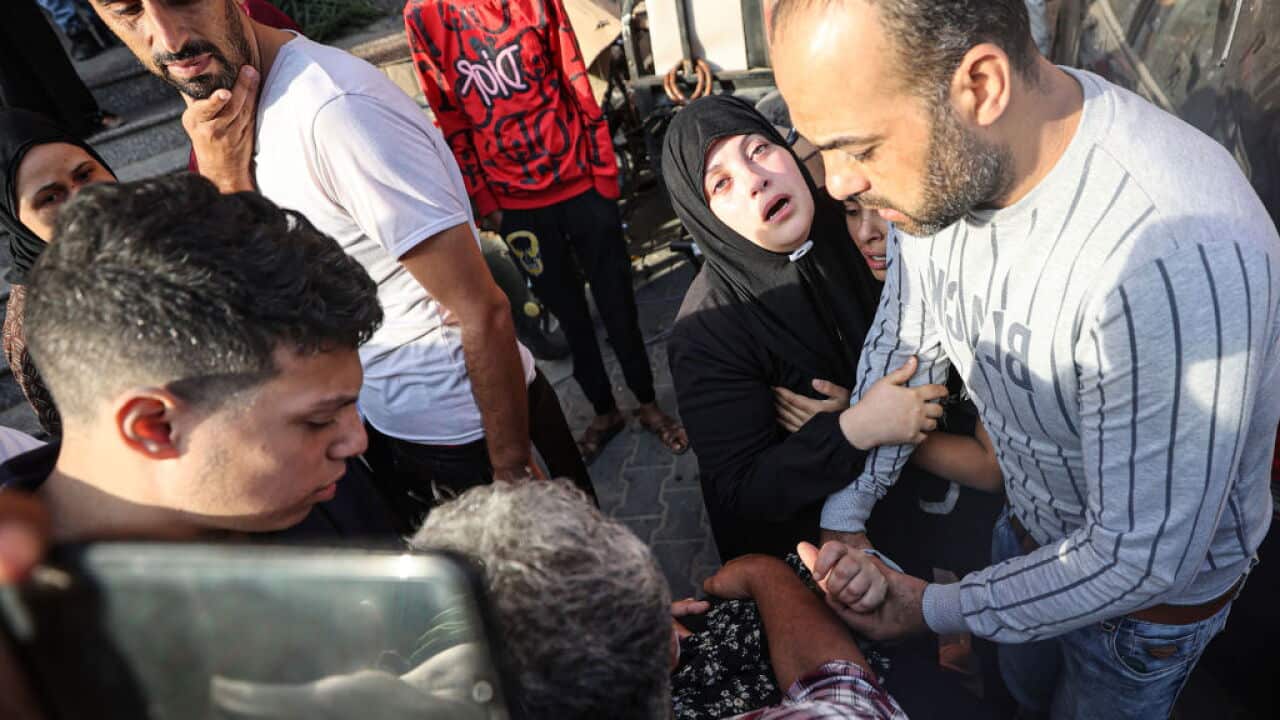
Palestinians wounded in Israel’s bombardment of the Gaza Strip arrive at a hospital in Khan Younis. Source: AAP / Fatima Shbair/AP
Riham Jafari, the organisation’s Coordinator of Advocacy and Communication in the Palestinian Territories, said the impact will be “devastating”.
“As thousands of Gazans flee in fear of their lives, abandoning their homes and communities, it is deeply concerning to witness the threats to target hospitals and critical infrastructure… Pregnant women make the impossible choice of fleeing with no guarantee of safety or remaining at risk of almost certain death.”
With no painkillers, patients are ‘screaming in pain’
There are fears its hospitals, already over-run with patients and desperately short of supplies, will also be completely cut off, while they may also be forced to evacuate.
On Tuesday, hundreds of Palestinians were killed after a bombing at Al-Ahli al-Arabi Hospital. A health ministry official attributed the attack to an airstrike from Israel’s military. Israel denied responsibility, saying the hospital was hit by a failed rocket launch by a Palestinian militant group.

Gaza’s main border crossings.
“The situation is catastrophic. Hospitals are overwhelmed and barely functioning at this stage,” a spokesperson for Médecins Sans Frontières (MSF) said in a statement.
Simon Eccleshall, head of programs at MSF Australia, says hospitals have for the last two days been rationing electricity and fuel for generators, prioritising ICUs and other lifesaving support.
“One would hope that there’d be a breakthrough in the coming hours to be able to avert what’s otherwise going to be a very preventable humanitarian crisis and a very large number of casualties.”
Hospitals becoming shelters for thousands
“Surprisingly we are still alive. The conditions here are miserable. We are without water, without food, without hygiene. People are sleeping and lying in the streets, in the corridors and everywhere inside the hospital.”

With Gaza’s border crossings closed, humanitarian aid is unable to enter the territory. Source: Getty / Ahmad Hasaballah
MSF said 10,000 people alone were seeking shelter at one hospital in Gaza’s north. The hospital only has 500 beds.
“Last night we slept for an hour or so. Woke up to rumours that we need to evacuate the entire Gaza city. We’re still in a shock. We left at around 5am… we packed suitcases for us. We had some food, we brought everything … We have no idea what’s going to happen, if we are going to make it back to Gaza City, if we are going to make it back to our homes.”
Once you turn off life support, it’s very hard for the patient to survive.
Simon Eccleshall, head of programs at MSF Australia
The Australian government has committed $10 million in humanitarian assistance to civilians affected by the Israel-Gaza conflict.
[ad_2]
Source link