Key Points
- Hamas has vowed to respond with ‘full force’ as Israeli air and ground forces step up operations in the Gaza Strip.
- Internet and mobile phone services were cut off in the Palestinian territory.
- Israel has rejected calls from its closest allies in the West to pause the attacks.
Hamas said on Saturday its militants in Gaza were ready to confront Israeli attacks with “full force” after Israel’s military widened its air and ground attacks on the Palestinian enclave.
The said late on Friday its fighters were clashing with Israeli troops in Gaza’s northeastern town of Beit Hanoun and in the central area of al-Bureij.
“The Al-Qassam brigades and all the Palestinian resistance forces are completely ready to confront (Israel’s) aggression with full force and frustrate its incursions,” Hamas said in a statement early on Saturday.
“Netanyahu and his defeated army will not be able to achieve any military victory,” referring to Israeli Prime Minister Benjamin Netanyahu.
Israel steps up air and ground attacks on Gaza
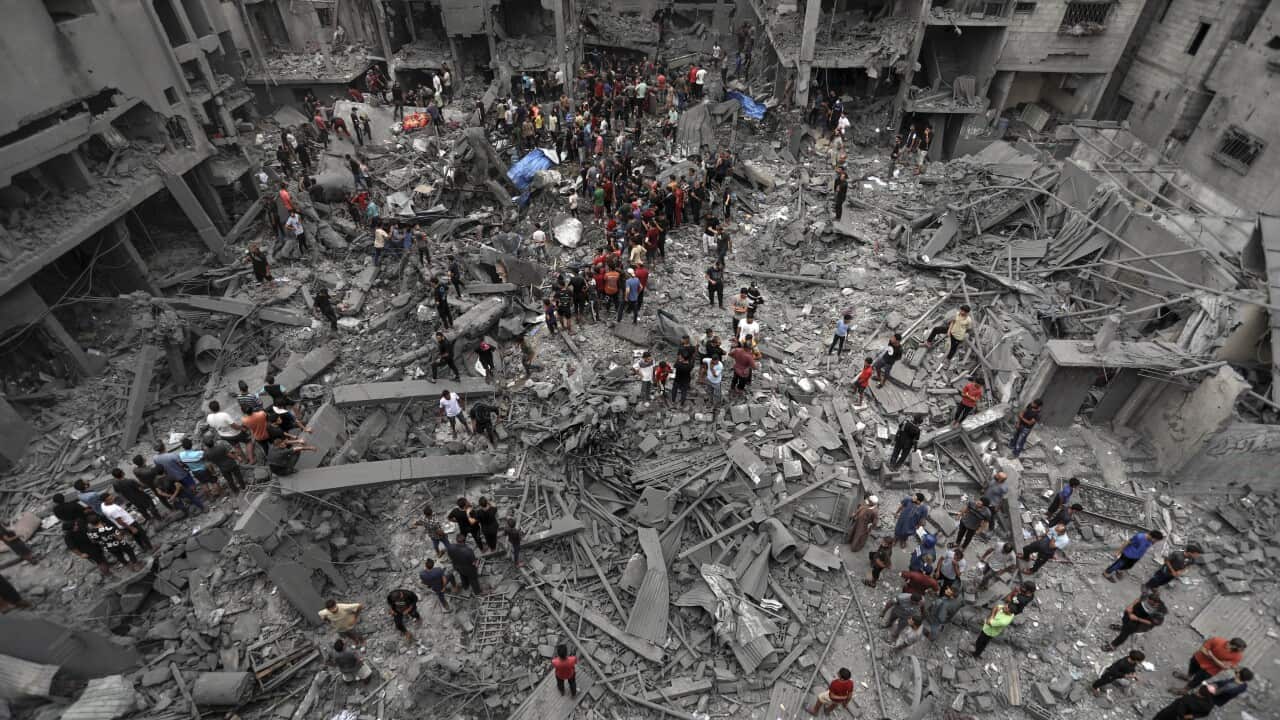
Israel’s chief military spokesperson said earlier on Friday that Israeli air and ground forces were stepping up , amid reports of heavy bombing of the besieged enclave.
Internet and mobile phone services were cut off in the Palestinian territory, a local telecoms firm and the Red Crescent said.
“In the last hours, we intensified the attacks in Gaza,” Rear Admiral Daniel Hagari told a televised news briefing.
A Palestinian sits in his damaged home after an Israeli airstrike in Khan Younis, southern Gaza Strip, Friday. Source: AAP / Fatima Shbair/AP
He said the air force was conducting extensive strikes on tunnels and other infrastructure.
“In addition to the attacks carried out in the last few days, ground forces are expanding their operations tonight,” he said, raising the question of whether a long-anticipated ground invasion of Gaza may be beginning.
Israeli forces have massed outside Gaza, where Israel has been conducting an intense campaign of aerial bombardment since .
Earlier on Friday, Palestinian mobile phone service provider Jawwal said that services including phone and internet had been cut by heavy bombardment.
A statement from the Palestine Red Crescent Society said it had completely lost contact with its operations room in Gaza and all its teams operating on the ground.
Israel is rejecting calls for respite in Gaza as its have coalesced around the idea of “humanitarian pauses”, or temporary stops to the bombardment.
Growing international distress at the conditions for 2.3 million people trapped under the heaviest air strikes Israel has ever unleashed on Gaza led major powers this week to call on Israel to allow such pauses to get aid in and Israeli hostages held by Islamist militant group Hamas out.
The issue has opened the first public split between Israel and backers including the United States, the EU, UK and other G7 members such as Japan over the campaign after tight alignment and support in the nearly three weeks since
“Israel is opposed to a humanitarian pause or ceasefire at this time,” Lior Haiat, Israel’s Foreign Ministry spokesperson, said on Friday, while a senior Israeli official said calls for a pause in fighting appeared in “poor faith.”
The chorus of appeals for a pause followed days of intense diplomacy at UN headquarters in New York and in Brussels, and was a compromise between those, such as Spain, who wanted to push Israel to call a ceasefire, and those who say Israel’s right to self-defence was foremost.
Israelis take cover as a siren warns of incoming rockets fired from the Gaza Strip, during the funeral of the Israeli man Sagiv Ben Svi, killed by Hamas militants while attending a music festival on 7 October. Source: AAP / Petros Giannakouris/AP
What is the situation in Gaza?
Israel has said it has been preparing a ground invasion of Gaza, but has been urged by the US and Arab countries to delay an operation that would multiply the number of civilian casualties in the densely populated coastal strip and might ignite a wider conflict.
Such an operation would exacerbate what aid groups call a humanitarian crisis in the territory following days of aerial bombardment that Palestinian health authorities in Hamas-run Gaza say has killed more than 7,000 Palestinians.
That followed a shock attack by hundreds of Hamas gunmen, who rampaged through Israeli communities close to the Gaza Strip, killing 1,400 people and dragging more than 200 into captivity. Hamas has linked the return of those hostages to a ceasefire in Gaza.
Concerns about the risk of a wider Middle East conflict have risen in recent days with the US dispatching more military assets to the region as Israel pummelled targets in Gaza and Hamas supporters in Lebanon and Syria.
Israeli leaders have vowed to wipe out Hamas, the Islamist movement that has run Gaza since 2007, and kill the leaders and planners of the 7 October assault, undeterred by pleas from humanitarian agencies to spare the civilian population.
Much of the infrastructure of Gaza, which has been living under blockade by Israel and Egypt since 2007, has been shattered by the Israeli bombing.
Power has been cut for days, crippling treatment facilities and depriving Gazans of fresh water, while half of its housing stock has been damaged and 20,000 residential units destroyed or rendered uninhabitable, according to the Hamas media office.
With Israel keeping up daily bombardments that laid waste to swathes of the densely populated strip, Palestinians said they received renewed to move from Gaza’s north to the south to avoid the deadliest theatre of the war.
Gazans say making the journey south remains highly risky amid air strikes and that southern areas have also been bombed.
Many families have refused to leave their homes, fearing a repeat of the experience of previous wars with Israel when Palestinians who left their homes and land were never able to return.
The significant escalation is the latest in a long-standing conflict between Hamas and Israel.
Hamas is a Palestinian military and political group, gaining power in the Gaza Strip since winning legislative elections there in 2006.
Hamas’s stated aim is to establish a Palestinian state, while refusing to recognise Israel’s right to exist.
Hamas, in its entirety, is designated as a terrorist organisation by countries including Australia, Canada, the UK and the US.
Some countries list only its military wing as a terrorist group.
The UN though did not condemn Hamas in its entirety as a terrorist organisation, due to insufficient support from member states to do so during a 2018 vote.