An Israeli air strike on Wednesday on the municipal building in Nabatieh, a major town in southern Lebanon, which serves as a provincial capital, killed the mayor Ahmed Kahil and at least five others, two security sources said.
The strike came despite U.S. concerns about rising death tolls and fears of all-out war in the region as Israel battles Iran-backed Hezbollah in south Lebanon and in the capital Beirut and the Palestinian militants .
The Israeli military said it struck dozens of Hezbollah targets in the Nabatieh area and dismantled underground infrastructure.
Israeli navy forces, meanwhile, have struck dozens of Hezbollah targets in southern Lebanon, in cooperation with troops on the ground, Israel’s military said on Wednesday.
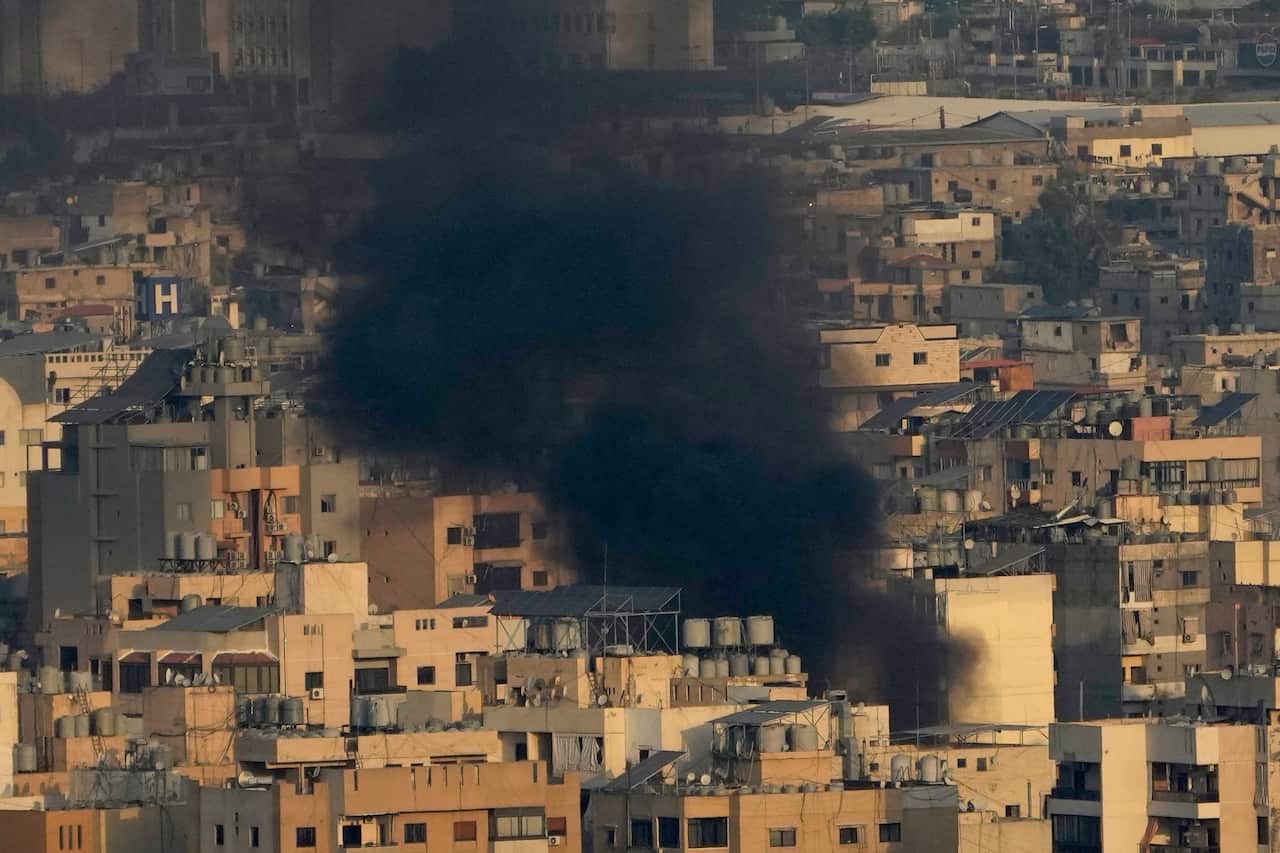
The last time Beirut was hit was on 10 October, when two strikes near the city centre killed 22 people and brought down entire buildings in a densely populated neighbourhood. Source: AP / Hussein Malla
Hours earlier at least one Israeli strike hit Beirut’s southern suburbs, Reuters witnesses said, after the US said it opposed the scope of Israeli attacks in Lebanon’s capital.
Reuters witnesses heard two blasts and saw plumes of smoke emerging from two separate neighbourhoods. It came after Israel issued an evacuation order early on Wednesday, which mentioned only one building.
The Israeli military has in recent weeks carried out strikes on Beirut’s southern suburbs, the stronghold of , without advance warnings, or with a warning for one area while striking more broadly.
The Israeli military said it conducted a strike on an underground Hezbollah weapons stockpile in the southern Beirut suburb of Dahiyeh.
“Prior to the strike, numerous steps were taken to mitigate the risk of harming civilians, including advancing warnings to the population in the area,” the Israeli military said.
Israeli military evacuation orders were also affecting more than a quarter of Lebanon, according to the UN refugee agency, two weeks after Israel began incursions into the south of the country that it says are aimed at driving back Hezbollah.
Some Western countries have been pushing for a ceasefire between the two neighbours, as well as in Gaza, though the United States says it continues to support Israel and was sending an anti-missile system and troops.
On Tuesday, State Department spokesperson Matthew Miller said the US had expressed its concerns to Prime Minister Benjamin Netanyahu’s administration on the recent strikes.
“When it comes to the scope and nature of the bombing campaign that we saw in Beirut over the past few weeks, it’s something that we made clear to the government of Israel we had concerns with and we were opposed to,” he told reporters, adopting a harsher tone than Washington has taken so far.
The last time Beirut was hit was on in a densely populated neighbourhood.
On Tuesday, Netanyahu told President Emmanuel Macron of France during a phone conversation that he opposed a unilateral ceasefire and said he was “taken aback” by Macron’s plan to hold a conference on Lebanon, according to an Israeli readout.
Israeli strikes in Lebanon have killed at least 2,350 people over the last year and left nearly 11,000 wounded, according to the health ministry, and more than 1.2 million people have been displaced.
The toll does not distinguish between civilians and combatants but includes hundreds of women and children.
The figures underscore the heavy price Lebanese are paying as Israel tries to destroy Hezbollah’s infrastructure in their conflict, which resumed a year ago when it began firing rockets at Israel in support of Hamas at the start of the Gaza war.