



Key Points
- Astronauts aboard the Artemis II are officially out of the Earth’s orbit and on their way to the Moon.
- Experts say the mission is part of a broader space race, with the United States and China competing.
For the first time in more than half a century, humans are on their way to the moon.
NASA’s Artemis II took off on Thursday morning and officially exited the Earth’s orbit on Friday, the first step on its ten-day mission to loop around the Moon and back.
The Orion capsule executed a key thruster firing that kicked the crew out of Earth’s orbit and onto a path toward the Moon — committing them to reaching the farthest distance humans have ever travelled in space.
But while many have been hooked by humans’ latest trip to space, it’s actually part of a much bigger story — with the second race to the Moon, and possibly to Mars, now well and truly on our doorstep.
What’s Artemis II’s mission?
First things first, the astronauts aboard NASA’s Artemis II aren’t actually landing on the moon.
They’re doing what’s called a lunar fly-by — looping around the Moon and returning to Earth without touching down.
Think of it like a dress rehearsal: a chance to prove that the hardware, the crew, and the life support systems can all work together in deep space before anyone commits to landing.
“Artemis is as much an engineering validation as a scientific one,” Richard de Grijs, professor of physics and astronomy at Macquarie University, said.
“After all, before you can do great science on the Moon, you must prove that you can get there (and back) safely — every single time.”
The ten-day mission is aimed at paving the way for a Moon landing in 2028.
It’s also the inaugural crewed flight of the Space Launch System — NASA’s new lunar rocket, designed to allow the United States to repeatedly return to the Moon with the goal of establishing a permanent base as a platform for further exploration.
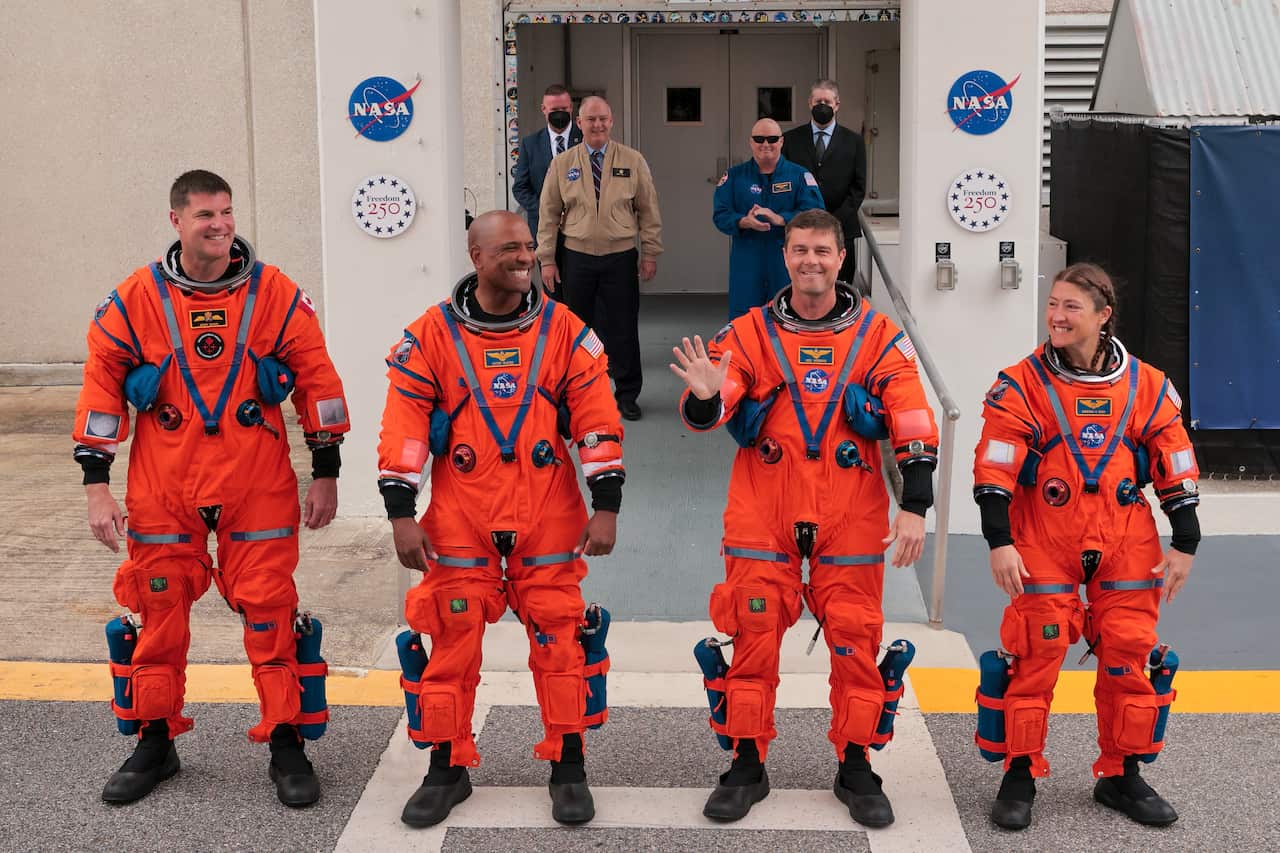
The four astronauts on board — NASA’s Reid Wiseman, Victor Glover and Christina Koch, and Canadian Space Agency astronaut Jeremy Hansen — will venture farther from Earth than any humans ever have, travelling more than 400,000 kilometres into space.
They’re expected to reach that distance on day six of the mission.
The mission also makes history in other ways, with the first woman, the first person of colour, and the first non-American on a lunar mission.
What are they hoping to learn from the Moon?
This time, it’s not just about planting flags.
The mission is part of a broader US goal to establish a base on the Moon within the next ten years — one that could ultimately serve as a launchpad for humans going to Mars.
“The Artemis program roadmap envisions crewed lunar landings by 2028, only two years away, and ultimately, the first step to send humans to Mars,” said Dr Guifré Molera Calves, a senior space researcher at the University of Tasmania.
A key focus is learning to live off the Moon itself.
The longer-term goal is staying, not just visiting the Moon, said Belinda Rich, PhD researcher in lunar metals manufacturing at Swinburne University of Technology.
“Establishing outposts for long-term habitation means solving entirely new challenges around infrastructure and mission sustainability. A major solution to many of those challenges is the processing of moon dust — known as lunar regolith — into usable resources,” Rich said.
“Apollo astronauts stayed for three days; Artemis IV astronauts will stay for a week. One day, a permanent lunar outpost will enable lunar visits lasting months or years.”
Dr Matt Shaw, research fellow in astrometallurgy at Swinburne, says the moon base will “allow us to better understand our near neighbour, as well as start leveraging the resources there to build up a cislunar economy”.
When was the last time humans were on the moon?
The last time astronauts walked on the moon — a feat so far achieved only by the United States — was the final Apollo mission in 1972.
While Artemis II won’t be landing, it’s the first crewed mission to the vicinity of the moon in 53 years.
During the Apollo program, humans landed on the Moon during six missions, with 12 men walking on the lunar surface in total.
There have also been plenty of human spaceflights in the decades since Apollo — just none that ventured beyond low-Earth orbit, and none headed toward the Moon.
Enter: China
Many experts believe Artemis II isn’t just a space mission — it’s a move in a geopolitical contest.
The current era of American lunar investment has frequently been portrayed as an effort to compete with China, which aims to land humans on the Moon by 2030.
During the post-launch briefing, NASA administrator Jared Isaacman said: “Competition can be a good thing. And we certainly have competition now.”
Professor Rodrigo Praino, director of the Jeff Bleich Centre at Flinders University, says the mission’s real driver is less scientific and more strategic.
“Artemis is basically less about what the US will find on the Moon and more about what the US will be missing out on if it does not go there,” he said. “The current US administration is very clear in its messaging: beat China, don’t cede the Moon, win Mars.”
“To cede the Moon is to signal something about the US position in the world order that goes far beyond the Moon itself.”
It’s also been compared to a “second space race”, Shaw said.
“This mission is the exciting first step in NASA’s newly announced $20 billion campaign to establish a base on the Moon in the next 10 years — a timeline that is intriguingly close to China’s proposed timeline to complete the initial stages of their International Lunar Research Station,” Shaw said.
“It is this similarity that is sparking comments of a second space race.”
The second global space race?
Marco Aliberti, associate director at the European Space Policy Institute, says the competitive pressure has already visibly reshaped the Artemis program.
“What began as an architecture built around partnerships and a long-term vision has been refocused almost entirely on a single imperative: return Americans to the lunar surface ahead of China,” he said.
“Yet, if FOMO and competitive anxiety are effective in the short term, they are less so to sustain a complex program on the long run.”
De Grijs argues the bigger story isn’t really a race at all.
“It is less about flags and footprints, and more about building the rules of the road in deep space,” he said. “This isn’t a new space race; it’s really a set of parallel space futures.”
“The real milestone is not reaching the Moon again, but learning how to stay there together. This decade will be defined not by who gets there first, but by who builds systems others can join and benefit from,” he said.
— With additional reporting by Agence France-Presse and Reuters.
For the latest from SBS News, download our app and subscribe to our newsletter.