
[ad_1]
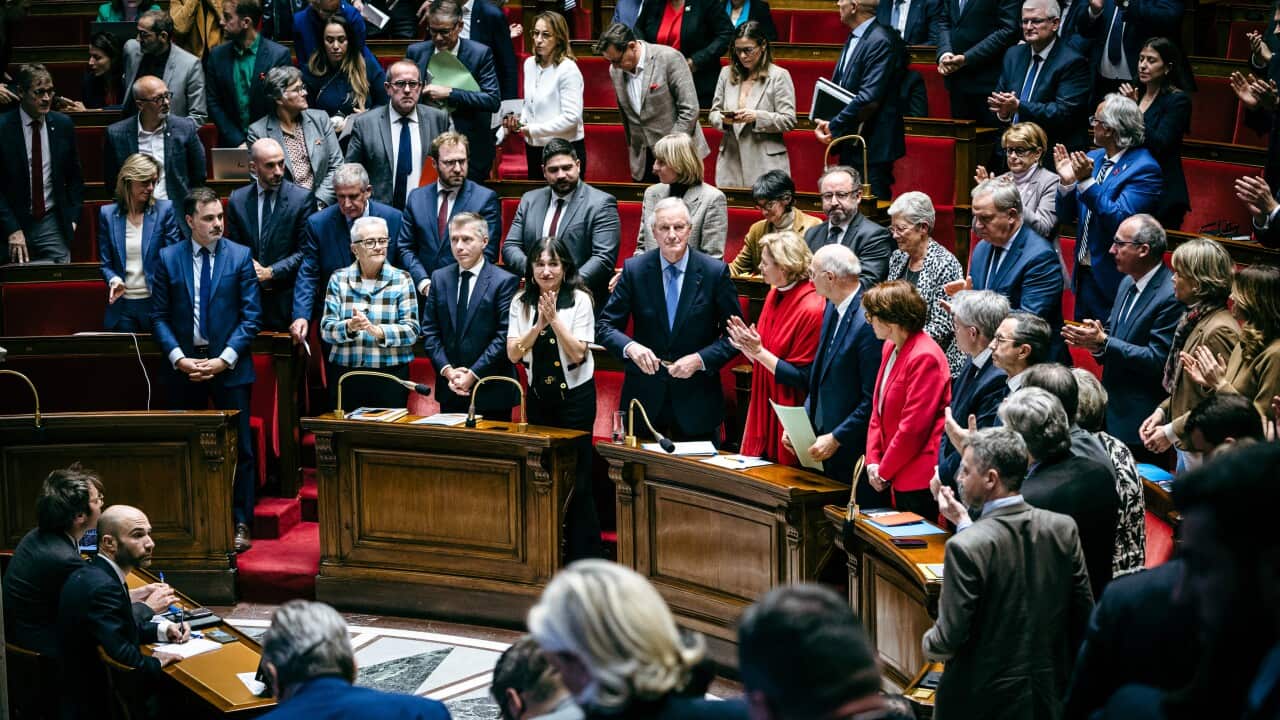
French opposition MPs voted to oust the government of Prime Minister Michel Barnier after just three months in office, a historic move which hurled the country further into political uncertainty.
For the first time in over sixty years, the National Assembly lower house toppled the incumbent government, approving a no-confidence motion that had been proposed by the hard left but which crucially was backed by the far-right headed by Marine Le Pen.
MPs joined forces to back the no-confidence motion, with a majority 331 votes in support of the move.
Barnier was expected to tender his resignation and that of his government to President Emmanuel Macron shortly.
What brought about Barnier’s downfall?
This time, Macron had ushered in the crisis by calling a snap election in June that delivered a polarised parliament.
With its president diminished, France risks ending the year without a stable government or a 2025 budget although the constitution allows special measures that would avert a US-style government shutdown.
The MPs punished Barnier for opting to use special constitutional powers to ram part of an unpopular budget, which sought 60 billion euro ($A98 billion) in savings in an effort to shrink the deficit, through parliament without a final vote.
National Rally chief Marine Le Pen had said collapsing the government was “the only way the constitution gives us to protect the French from a dangerous, unfair and punitive budget”.

No French government had lost a confidence vote since Georges Pompidou’s in 1962. Source: AFP / Stephane De Sakutin
What’s next for France?
France faces a period of deep political uncertainty that is already unnerving investors in French sovereign bonds and stocks.
Earlier this week, France’s borrowing costs briefly exceeded those of Greece, generally considered far more risky.
Macron must now make a choice.
Three sources told Reuters that Macron aimed to install a new prime minister swiftly, with one saying he wanted to name one before a ceremony to reopen the Notre-Dame Cathedral on Saturday.
Any new prime minister would face the same challenges as Barnier in getting bills, including the 2025 budget, adopted by a divided parliament.
There can be no new parliamentary election before July.
Macron could alternatively ask Barnier and his ministers to stay on in a caretaker capacity while he takes time to identify a prime minister able to attract sufficient cross-party support to pass legislation.
The danger for Macron is that his opponents vote down one prime minister after the next.
[ad_2]
Source link