

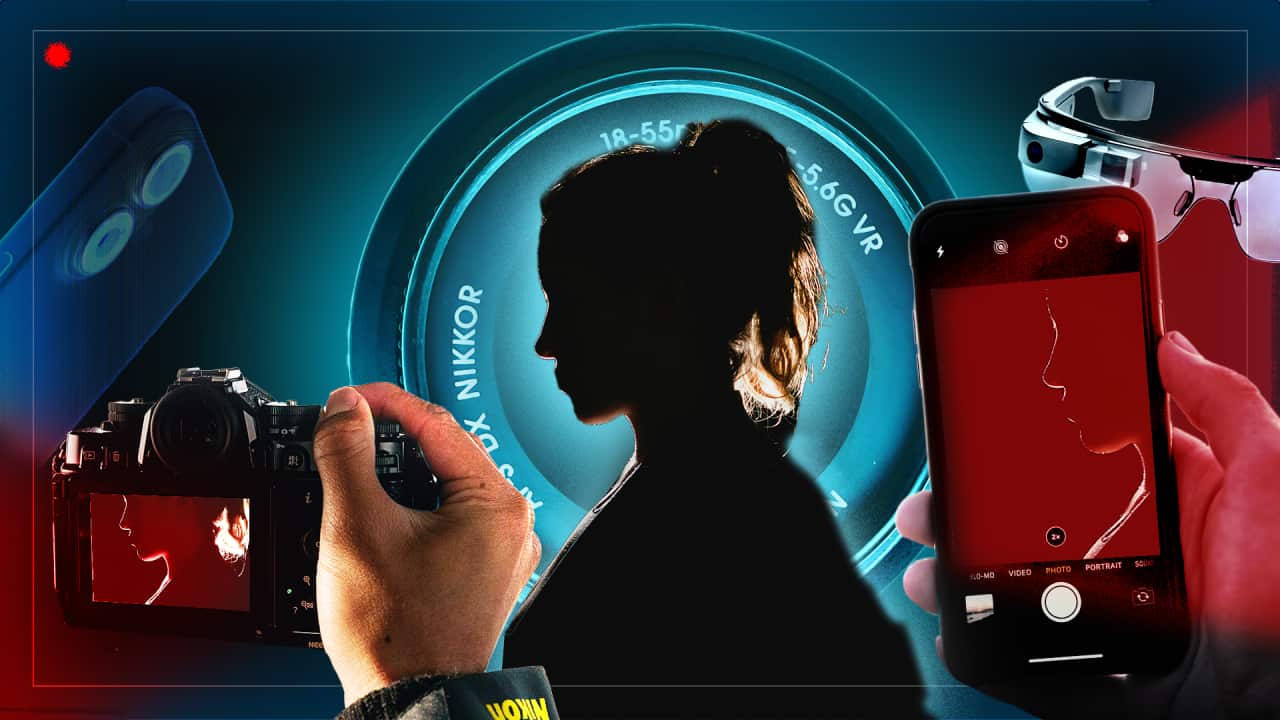
A smartphone. A compact camera. Everyday devices that seem innocuous enough. But these tools, designed to help people capture life’s unforgettable moments, are now being used to spy on Australian women.
In December, Victoria Police laid 775 charges against a junior doctor, Ryan Cho, for allegedly filming hospital workers with a concealed phone inside the staff toilets of several Melbourne hospitals.
Cho was already facing 133 charges — including alleged stalking, producing an intimate image and installing a surveillance device — now totalling 908.
A Sydney man was also charged last August after allegedly filming teenage girls in public via hidden cameras, modified to fit underneath his shoelaces.
Fresh data requested by SBS News also shows a rise in charges for offences relating to non-consensual intimate recordings — a form of image-based abuse — in NSW and Victoria.
According to the NSW Bureau of Crime Statistics and Research, the number of charges laid for “intentionally recording intimate images without consent” rose from 25 in 2017-2018 (when data was first collected) to 316 in 2024-2025.
The highest figure recorded for this offence was 453 in 2023-2024.
Data from Victoria’s Crime Statistics Agency (CSA) similarly shows an overall increase in the number of charges related to image-based abuse over the past three years — including producing and distributing intimate images — up from 82 in 2022-2023 to 106 in 2024-2025.
CSA’s findings also show that education was the most common community setting for these offences, followed by retail.
But as technology continues to evolve, women in Australia and around the world may also face evolving approaches to image-based abuse. Despite the efforts of lawmakers to introduce tougher regulations, loopholes remain.
From ‘revenge porn’ to secret filming in public
Since 2017, both federal and state and territory governments have launched legal reforms to protect Australians from ‘revenge porn’, which refers to non-consensual sharing of intimate images, often as an act of punishment or sexual extortion.
Currently, all states and territories except Tasmania have criminalised the act of distributing or threatening to distribute intimate images of others without consent.
In some states, such as NSW and Queensland, there are also offences for recording intimate images without consent, which addresses behaviours such as ‘upskirting’ — recording images of someone with a camera positioned underneath their clothing.
Tom Sulston, co-founder and head of policy at Digital Rights Watch, describes the current framework as “a mishmash”.
“It’s not that there is one single federal law that covers the whole issue, and because different states have different legislation, there are subtly different interpretations between them.”
According to Sulston, there are nuances in how each jurisdiction defines an intimate photo.
“In some states, it has to be quite specific, like it involves nudity, whereas in Queensland, for example, the wording is a bit broader. It doesn’t necessarily have to be a sexually explicit image,” he says.

In November 2024, SBS’ The Feed reported that an American influencer used Google glasses to film interactions with women in public spaces around Sydney, including a restaurant and university campus, without their knowledge or consent.
While the act doesn’t violate any laws, the videos were posted online and attracted misogynistic and sexualised comments.
According to Sulston, while it’s legal to take photos in public, there are rules around non-consensual image distribution that people can use to protect themselves.
In June 2025, the federal government’s new privacy law came into force, introducing the right to sue for invasion of privacy in cases where non-consensual image distribution is intentional and has caused harm.
Sulston says the tort could be a powerful tool for women to protect themselves from image-based abuse.
“So that may give someone … a good cause to say, ‘I was on the beach, you took a photograph of me, and now you’ve uploaded it to this online community where kind of awful men are talking about me horribly’,” Sulston says.
But the law is still new and hasn’t been tested so far, he says.
“It’s very good legislation. We need to use it. A lot of lawyers kind of don’t know about those changes yet.”
How do other countries tackle the issue?
Across Asia, image-based sexual abuse has dominated headlines over the past few years. But as governments rushed to address the issues, various barriers emerged.
South Korea
In South Korea, ‘molka’ — which refers to upskirting and the use of spycams, often in public toilets and changing rooms — has sparked several national protests since 2018. The term loosely translates to ‘hidden camera’.
In 2020, a South Korean pay-to-view group chat on Telegram was found to sell and distribute videos of women being blackmailed to perform sexual acts.
The scandal, also known as the Nth Room, grabbed international attention and pushed the South Korean government to launch reform on image-based sexual abuse.

In the same year, the government criminalised the possession, purchase, storage and viewing of non-consensually captured images.
Convicted offenders can now face up to three years in jail.
Yenn Lee, a digital researcher at the School of Oriental and African Studies, tells SBS News the enforcement of the law “remains weak”.
This is partly because the crime has become so widespread that authorities struggle to keep pace, and partly because ‘molka’ has historically not been treated with the seriousness it warrants.
Lee also says the reforms haven’t been “consistently sustained”, particularly when it involves encrypted, foreign-based platforms facilitating the abuse.
“Telegram, for example, remains a breeding ground for new forms of image-based sexual abuse, including the ‘deepfake pornography’ scandal that implicated hundreds of schools and universities in 2024,” she says.
Hong Kong
The Hong Kong government recorded 172 cases of voyeurism in 2024 — a 23.4 per cent increase from 2023.
According to Hong Kong Police, most cases occurred in crowded locations such as public transport and shopping malls, and 98 per cent of them involved secret filming via smartphones.

In 2021, the Hong Kong government also passed laws criminalising recording, distributing or threatening to distribute photos of a person’s intimate parts without their consent.
The law also states that it’s a criminal offence to record intimate images of an individual when they are in circumstances that “give rise to a reasonable expectation of privacy”.
Cheryl Yip, advocacy officer at the Association Concerning Sexual Violence Against Women (ACSVAW), says the wording around expectation of privacy allows the law to cover unlawful filming in pseudo-public spaces, such as public toilets and changing rooms.
However, she cites a 2023 case in which a man was found not guilty after he was caught secretly taking photos of a woman’s thighs and bottom in a supermarket with his phone.
Although the judge in this case described the man’s behaviour “disgusting” in his concluding statement, it was ruled that the man did not commit an offence, as the photos didn’t contain any intimate parts, local media reported.
China
In China, there have been calls for stricter laws to tackle digital sexual violence after many women found sexually explicit photos of them being secretly taken by strangers, or ex-partners, on a Telegram group of more than 100,000 members in August 2025.
Severe cases could be subject to criminal charges or imprisonment, as many forms of digital sexual violence fall under China’s updated Public Security Administration Punishments Law, due to come into effect in January.

Under the latest version of the law, any individual who produces, circulates, or profits from obscene materials via “information networks” or “telecommunication networks” could face up to 15 days of detention and fines of up to ¥5,000 ($1,021) — up from ¥3,000 ($612) under the previous version.
In particular, it adds that tougher punishment will be applied if minors are featured in the materials.
The amendment has sparked concerns about surveillance due to its broad reference to distribution platforms, and some have argued online that it covers consensual intimate photo exchanges, for example, between couples in private online chats.
Chinese media has disputed the claim, saying the amended wording is intended to address “emerging information-spreading technology”.
China has also introduced regulations specifically targeting the use of hidden cameras, which have helped tackle instances of upskirting and secret filming that may not involve sexually explicit content, according to Ling Li, researcher of China’s digital sexual violence at the University of Melbourne.
The Administrative Law also states that individuals who illegally install hidden cameras or listening devices could be subject to detention and fines.
In February 2025, following online complaints of hidden cameras installed in hotels, the municipal government in Guangdong — a province in south-east China — introduced industrial regulation for the province’s hotel and accommodation sector.
It stipulates that hotel operators and other accommodation providers bear the responsibility for detecting and removing hidden cameras in their rooms.
Associate professor Chun Pang from Peking University told Chinese media that while this industrial regulation “fills the gap” between predators and victims, there was still uncertainty around the extent to which it could be implemented.
Can legislation keep up with technology?
On home turf, Sulston says reforms, including those made to the Privacy Act last year, are a “good start”.
However, it can take time for lawmakers to respond to evolving technology, and women — who are often targeted in secret filming — shouldn’t bear the weight of protecting themselves in the meantime, he says.

“A lot of people don’t know about those changes, and so they don’t know that that’s an option open to them, to seek redress if they’ve been harmed in this way,” Sulston says.
“I don’t think women should be forced to live quieter lives that don’t involve going out in public.
“So rather than … putting the onus on women to change their behaviour, to account for the fact there are creepy men in the world, I would rather say, ‘how are we holding those creepy men to account and stopping them from doing that?'”
Bystanders also play a role when secret filming occurs, Sulston says.
Sometimes it’s hard to tell if someone is secretly filming a person and being creepy … Sometimes it’s pretty obvious, and it should be straightforward to us as a society to say, ‘Hey, don’t do that’.
Yip also believes bystanders play an important role in stopping the secret filming of women.
“Hong Kong is a congested city, often these secret filming incidents take place [on] public transport or shopping mall escalators. These are venues where bystanders can play good roles in stopping the secret filming,” she says.
ACSVAW also runs an awareness program on social media that educates people on how to be a proactive bystander online.
“Nowadays, many people may turn to social media to seek support after experiencing secret filming, and they may receive various comments,” Yip says, adding the organisation shares information about how to support victims when you see image-based abuse on social media.

Jessica Lake, who specialises in privacy and feminist legal theory at Melbourne Law School, says while it’s important to be an active online bystander, there could be safety risks involved if individuals confront those filming in public spaces.
She says education for young people on the use and misuse of people’s images online is crucial to prevent digital sexual violence, along with education about consent and respect.
“We’ve got lots of very specific laws that emerged over time to respond to particular technologies,” she says.
“I don’t think that they’re necessarily very helpful, because technology then just evolves and creates new problems.
“I think having broad laws that are based in human values are more important, and that’s why laws like privacy laws, which are couched around human dignity and freedom from violation, can evolve with time, and they do.”
For the latest from SBS News, download our app and subscribe to our newsletter.