Key Points
- Israel is continuing to bombard Gaza and parts of southern Lebanon.
- The US has announced a new deployment of advanced air defences to support Israel.
- Palestinians have called on the international community to create “a united front” to stop Israel’s attacks on Gaza.
Israel has bombarded Gaza with airstrikes and its aircraft struck southern Lebanon, as Israeli Prime Minister Benjamin Netanyahu convenes a meeting of his top generals and his war cabinet to assess the escalating conflict.
Israel’s attacks concentrated on the Gaza Strip’s centre and north, Palestinian media reported.
A strike on a house near the Jabalia refugee camp, in northern Gaza, killed several Palestinians and wounded others, according to media reports.
Health authorities in Gaza said at least 4,600 people were killed in Israel’s two-week bombardment that began after Hamas’ on southern Israeli communities, in which 1,400 people were killed and 212 were taken into Gaza as .
The significant escalation is the latest in a long-standing conflict between Hamas and Israel.
Hamas is a Palestinian military and political group, gaining power in the Gaza Strip since winning legislative elections there in 2006.
Hamas stated aim is to establish a Palestinian state, while refusing to recognise Israel’s right to exist.
Israel has been massing troops along the Gaza border. Source: AAP, EPA / Abir Sultan
Palestinian Hamas leader Ismail Haniyeh and Iranian foreign minister Hossein Amir-Abdollahian discussed in a call late on Sunday the means of stopping Israel’s “brutal crimes” in Gaza, Hamas said in a statement.
Israel has near the fenced border around Gaza for a planned ground invasion aiming to annihilate .
Fears that the Hamas-Israel war could mushroom into a wider Middle East conflict rose over the weekend, with Washington warning of a significant risk to United States interests in the region and announcing a new deployment of advanced air defences.
The Pentagon has already dispatched a significant amount of naval power to the Middle East, including two aircraft carriers, support ships and about 2,000 marines, to help deter attacks by Iran-affiliated forces.
“What we’re seeing … is the prospect of a significant escalation of attacks on our troops and our people throughout the region,” US Defence Secretary Lloyd Austin told American network ABC’s This Week program on Sunday.
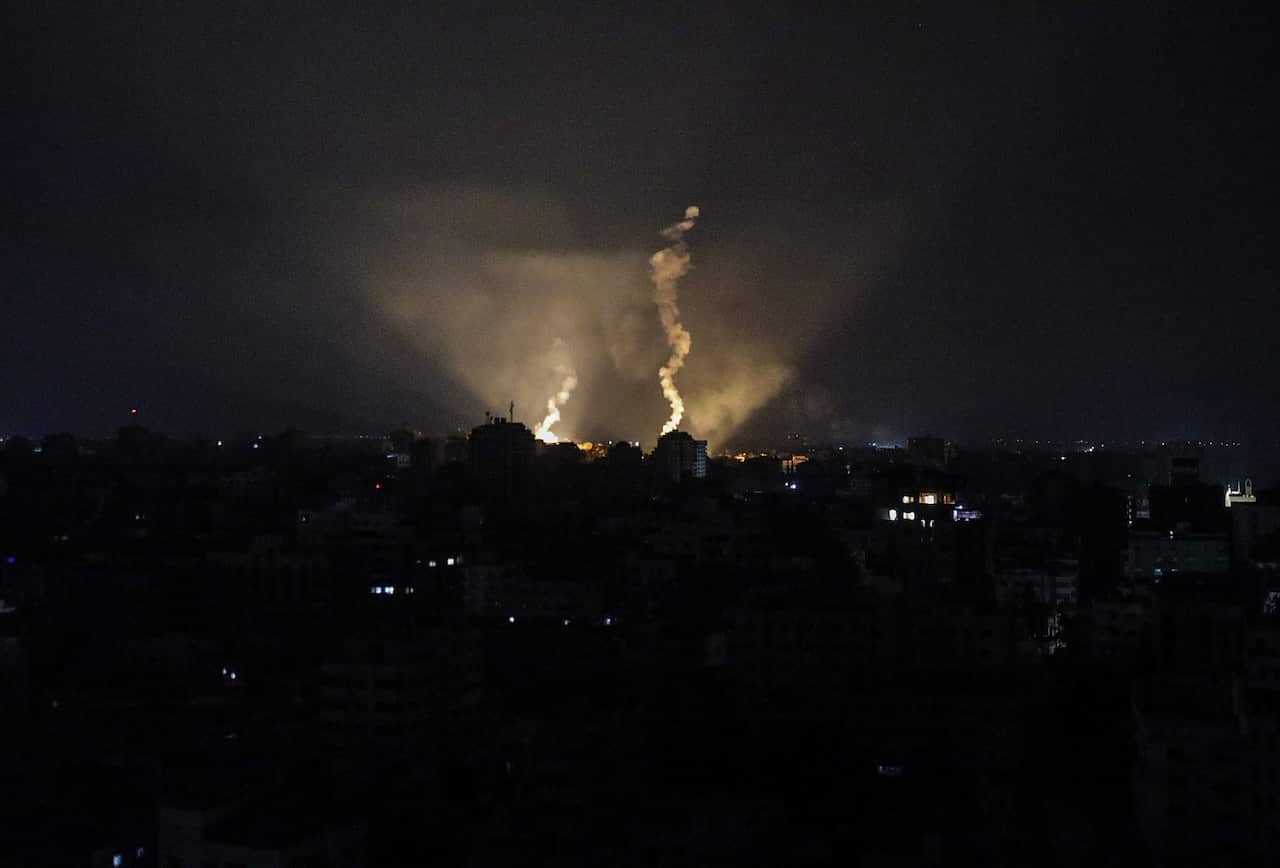
Israeli army flares illuminate the sky over Gaza City. Source: EPA / Mohammed Saber
Iranian security officials told Reuters Iran’s strategy was for Middle East proxies like to pursue limited strikes on Israeli and US targets but to avoid a major escalation that would draw in Tehran, a high-wire act for the Islamic Republic.
Hezbollah is a Lebanese Islamist political party and militant group formed in 1982 after Israeli forces invaded southern Lebanon that year.
It is backed by Iran and leads a multi-party alliance that holds just under half the seats in Lebanon’s parliament.
In neighbouring Syria, where Hamas’ main regional backer Iran has a military presence, Israeli missiles hit Damascus and Aleppo international airports early on Sunday, putting both out of service and killing two workers, Syrian state media said.
Along Israel’s northern border with Lebanon, the Iran-backed Hezbollah group has clashed with Israeli forces in support of Hamas in the deadliest escalation of frontier violence since an Israel-Hezbollah war in 2006.
Early on Monday, Israeli aircraft struck two Hezbollah cells in Lebanon that were planning to launch anti-tank missiles and rockets toward Israel, its military said.
Israel’s military also said it struck other Hezbollah targets, including a compound and an observation post.
With violence around its heavily guarded borders increasing, Israel on Sunday added 14 communities close to Lebanon and Syria to its evacuation contingency plan in the north of the country.
Palestinian Prime Minister Mohammad Shtayyeh called on the international community to create “a united front” to stop Israel’s attacks in Gaza and allow which has only begun to trickle in.
A second convoy of 14 aid trucks entered the Rafah crossing to the besieged Gaza Strip on Sunday night, and US President Joe Biden and Netanyahu affirmed in a call “there will now be continued flow of this critical assistance into Gaza,” the White House said.
The United Nations humanitarian office said the volume of aid entering so far was just 4 per cent of the daily average before the hostilities and a fraction of what was needed with food, water, medicines, and fuel stocks running out.
A second convoy of humanitarian aid for the Gaza Strip entered the enclave via the Rafah border crossing on Sunday. Source: AAP / Mohammed Asad/AP
Biden also ramped up his diplomacy, convening calls on Sunday with Netanyahu and Pope Francis and speaking with the leaders of Canada, France, Britain, Germany, Italy and Britain about getting aid into Gaza and preventing the conflict from spreading.
In a joint statement, the leaders voiced support for Israel’s right to defend itself.
They also called for adherence to international humanitarian law, including the protection of civilians.
Netanyahu also held a phone call with the leaders of France, Spain and the Netherlands late on Sunday, the Israeli leader’s office said.
Dutch Prime Minister Mark Rutte will visit Israel on Monday and French President Emmanuel Macron will visit Tuesday.