

Key Points
- Iran slams Australia for ‘taking side with the aggressors’.
- Europe and Japan will ‘join efforts’ to open the Strait of Hormuz.
Iran’s foreign ministry spokesperson Esmaell Baghaei conceded that Australian military assets in Gulf could become targets in the expanding war in The Middle East, while criticising Australia’s offer of asylum to players from Iran’s women’s football team.
Speaking to the ABC’s 7:30 on Thursday evening, Baghaei told host Sarah Ferguson that Australia has decided to stand with the United States and Israel, and Iran won’t distinguish “between offensive and defensive operations”.
” As I said … we have the inherent right to self-defence against offensive or defensive operation against us. We cannot recognise that those military assets that are being deployed to intercept missiles or drones against the aggressors would be regarded simply as defensive,” Esmaell said.
“That’s going to be part of this aggression.”
Australia has deployed an E-7A Wedgetail, a long-range reconnaissance aircraft with supporting Australian Defence force personnel to the Gulf area, following requests from the Gulf country.
In a joint statement on March 10, Prime Minister Anthony Albanese said the deployment wasn’t to take offensive action against Iran, but to protect Australians in the region.
In response to Ferguson’s question on whether Australia would be seen as a legitimate target by Iran, Baghaei repeated that Australia had taken “the wrong side of history”.
“I think it is very regrettable that the Australian government has decided to be on the wrong side of history by taking side with the blatant aggressors against Iran,” he said.
Iran accuses Australia of ‘coercing’ footballers
Baghaei has also accused Australian officials of taking Iran’s women footballers “hostage”, after seven Iranian footballers sought asylum in Australia, but five of them withdrew from the decision and now returned to Iran.
Baghaei insisted the Iranian footballers didn’t seek asylum.
“They didn’t seek asylum. They were forced to. They were coerced to as asylum. They didn’t do it voluntarily,” he said.
Citing the footballers’ coach, he claimed the women were invited into a room as they were told to clarify doping, but were asked to sign the papers that granted them asylum.
He also said Home Affairs Minister Tony Burke’s photo with five women’s footballers who initially sought asylum was “a shameful sham posture”.
This month, seven members of the football team who were in Australia for the Asian Cup were granted humanitarian visas — but one member decided to return to Iran, hours after accepting the offer.
Now, five of the team members who had accepted asylum have also decided to return home to Iran.
The home affairs minister said that, prior to the delegation arriving in Australia for the tournament, he worked with security agencies to ensure those associated with the Islamic Revolutionary Guard Corps — a government-listed terrorist organisation — were not granted visas to enter the country.
“Not everyone who applied for a visa [ahead of the tournament] got one. People who were connected to the IRGC were not granted visas,” Burke said.
He said when the team touched down in Sydney before flying out of the country, Home Affairs officials individually took all players and their support people into a room — without minders present — to extend them a similar offer.
The individual meetings, that Burke described as “emotional”, gave each woman a choice, following advocates’ concerns that the women were being coerced into returning to Iran.
“What we made sure of was there was no rushing, there was no pressure,” Burke told reporters in Canberra.
“Ultimately in Sydney, none of those individuals made the decision to take up the offer from Australia.”
Europe and Japan join to open Hormuz
On Thursday, the leaders of the United Kingdom, France, Germany, Italy, the Netherlands and Japan issued a joint statement, urging “an immediate comprehensive moratorium on attacks on civilian infrastructure, including oil and gas installations”.
The leaders also said they would act to stabilise energy markets and join “appropriate efforts” to open the Straits of Hormuz, which has been closed since the war in the Middle East broke out.
“We will take other steps to stabilise energy markets, including working with certain producing nations to increase output.”
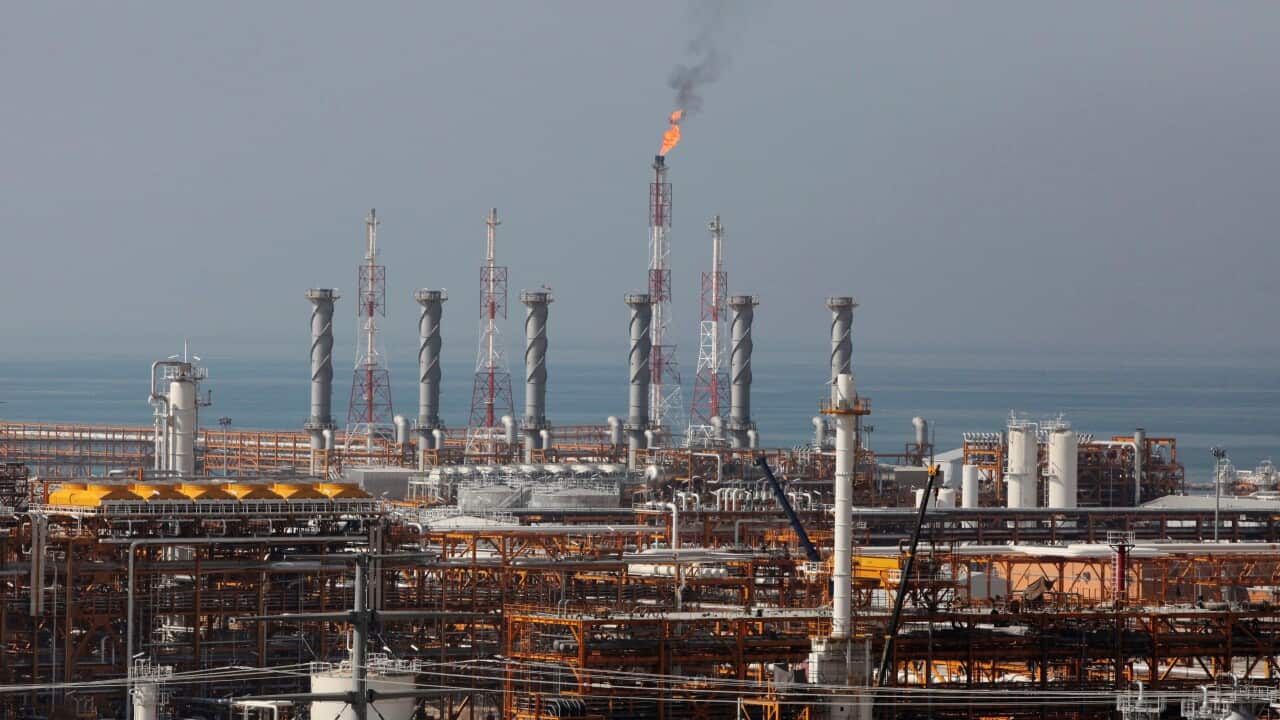
European gas prices surged 25 per cent and oil gained 10 per cent on Thursday, after Iran attacked and caused extensive damage to the world’s largest gas plant in Qatar on Wednesday.
Speaking to reporters on Thursday, US Defence Secretary Pete Hegseth said the objectives for the US to launch attacks on Iran remained to destroy the country’s missile launchers and block Iran’s opportunity to develop nuclear weapons.
The United States has carried out strikes against 7,000 targets inside Iran and hit more than 40 Iranian mine-laying vessels and 11 submarines, according to the Pentagon.
For the latest from SBS News, download our app and subscribe to our newsletter.