
[ad_1]
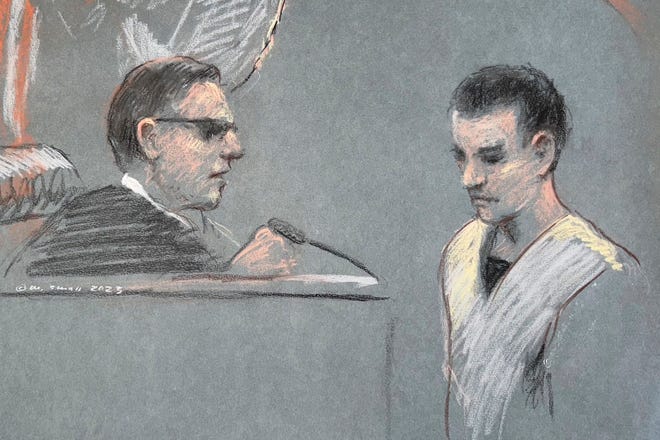
Prosecutors argued that Jack Teixeira, the Air National Guardsman who allegedly released Pentagon secrets on social media, had an “arsenal” of weapons and could flee the charges against him if released from jail, in anticipation of his bond hearing Thursday.
Teixeira, 21, of North Dighton, Massachusetts, is charged with unauthorized retention of national defense information and unauthorized removal of classified documents.
U.S. Magistrate Judge David Hennessy set a bond hearing for 1 p.m. Thursday.
‘A virtual arsenal of weapons’
In a court filing Wednesday, prosecutors said he kept a gun locker near his bed that held weapons including handguns, bolt-action rifles, shotguns and an AK-style high-capacity weapon. FBI agents searched the dumpster outside his house and found a military-style helmet, a mounting bracket used to attach a camera to the helmet and a GoPro camera.
“A search of the Defendant’s primary and secondary residences – that of his mother and father – also revealed the existence of a virtual arsenal of weapons, including bolt-action rifles, rifles, AR and AK-style weapons, and a bazooka,” prosecutors said.
Teixeira also appeared fixated with mass killings, according to prosecutors:
- In November 2022, he said he would “kill a (expletive) ton of people” because it would be “culling the weak minded.”
- In February 2023, he told a social-media user he was tempted to convert a specific type of minivan into an “assassination van.”
- In February 2023, he sought advice from another social-media user for what type of rifle would operate easily from the back of an SUV. He described how he would shoot in a “crowded urban or suburban environment.”
FBI Special Agent Luke Church said in a court filing Teixeira used his government computer in July 2022 to search the following terms: “Ruby Ridge,” “Las Vegas shooting,” “Mandalay Bay shooting,” “Buffalo tops shooting,” and “Uvalde.” The searches were unrelated to his job, according to Church.
Teixeira also represents a risk of fleeing the charges because he faces up to 25 years in prison if convicted and the loss of his military career, prosecutors said. He may still have access to a trove of classified documents that “would be of tremendous value to hostile nation states that could offer him safe harbor and attempt to facilitate his escape from the United States,” prosecutors said.
“The Defendant has already proved himself to be untrustworthy. The Defendant has already proved himself to be a danger to the U.S. national security,” U.S. Attorney Rachael Rollins said in a court filing to keep Teixeira detained. “And in light of the physical danger posed by the Defendant if released, there is simply no condition or combination of conditions that can be fashioned to adequately address and mitigate the risk posed by his release.”

Pentagon suspends officials at Teixeira’s base
The Air Force has suspended the top commander and two other officials at the 102nd Intelligence Wing at Otis Air National Guard Base where Teixeira served, according to Ann Stefanek, an Air Force spokesperson.
The Air Force has also temporarily removed the commanders’ access to classified systems.
The suspensions follow the opening of an Air Force inspector general’s investigation of the leak of classified information by Teixeira.
Teixeira had been called up to active duty in September along with other Guardsmen at the base. Airmen there help sift through the torrent of intelligence the Air Force collects by spy drones and other aircraft.
Teixeira’s job, essentially an IT tech for the intelligence, gave him access to the Pentagon’s internal computer systems, including one of the most sensitive. Known as the Joint Worldwide Intelligence Communication System, or JWICS, it is essentially the Pentagon’s internet for classified documents.
Teixeira would have had access to JWICS to help maintain it, not as an intelligence analyst, according to Scott Murray, a retired Air Force colonel and intelligence expert. Teixeira likely wouldn’t have had unfettered access to the most sensitive information such as the President’s Daily Brief, a distillation of the latest critical intelligence collected around the world.
Still, Teixeira’s access allowed him to see – and pilfer – a trove of sensitive information, including daily battlefield updates and assessments of U.S. allies and adversaries. It’s estimated that hundreds of people inside the federal government, including contractors, have similar access.

[ad_2]
Source link