
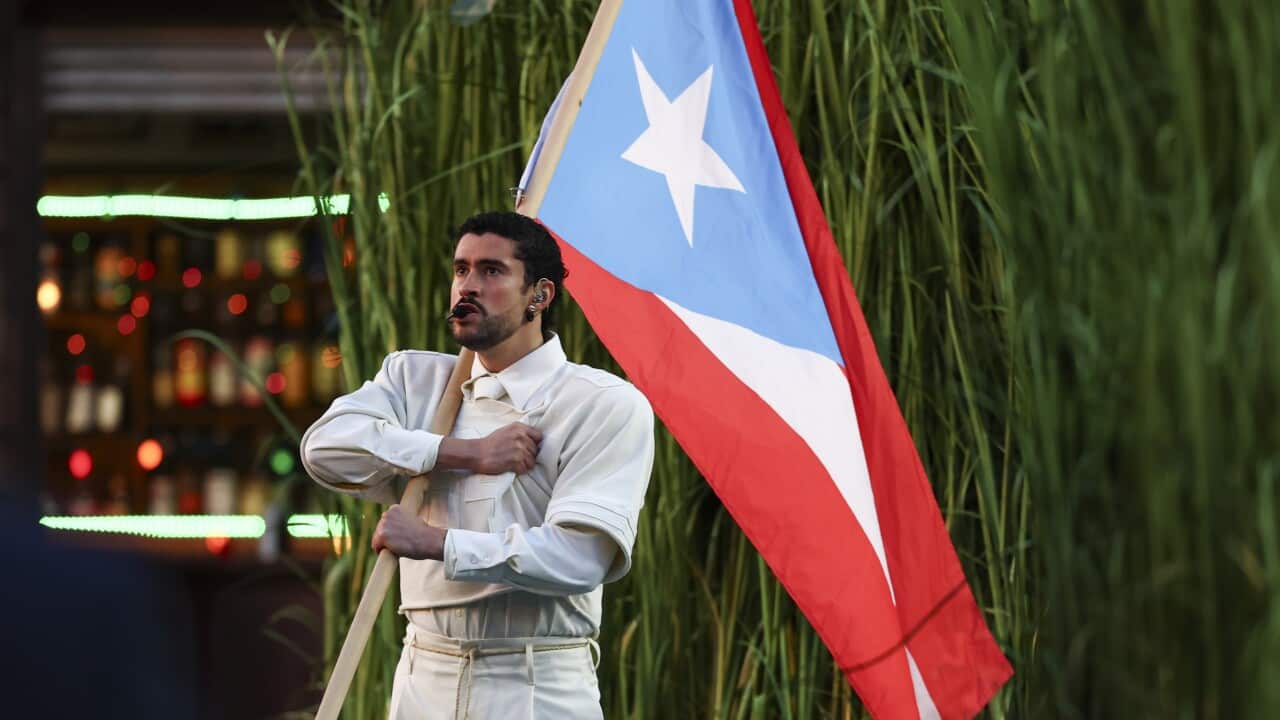
Bad Bunny’s history-making Super Bowl performance was stacked with symbolism, celebrating Latin American pride and Puerto Rican culture on one of the world’s most-watched stages.
The show simultaneously leaned in to love, joy and diaspora identity while sending a political message at a time when the United States has been gripped by division and an increasingly violent crackdown on immigrant communities.
The Puerto Rican rapper was applauded for delivering this missive in a way that resonates with mainstream audiences — not just in the US, but to communities navigating pride and identity around the world — as he became the first Spanish-language Latin solo artist to headline the iconic halftime show.
Experts have said the halftime show, and the way it’s been received globally, represents a “highly significant” moment of cultural significance and demonstrates the powerful voice of Spanish-speaking people in the US.
Fellow Latin artists J.Lo and Shakira co-headlined the halftime show in 2020, garnering 103 million viewers, according to ESPN. Bad Bunny’s 13-minute performance, an homage to life in Puerto Rico, gave an estimated 135.4 million viewers a taste of his universe.
During the opening song, set to his hit Tití Me Preguntó, the rapper was at first surrounded by labourers wearing pava straw hats in sugarcane fields. He then walked through a vibrant neighbourhood that included a coconut and taco stand, piragua snow cones, a boxing match and men playing dominoes.
The show featured guest performances from Lady Gaga, who did a salsa version of Die With a Smile, and Puerto Rican singer Ricky Martin, who sang Lo Que le Pasó a Hawaii.
There were cameos from Chilean American actor Pedro Pascal, Cardi B, who has Caribbean heritage, and Mexican American movie star Jessica Alba.
Towards the end of the performance, Bad Bunny declared “God bless America”, and then proceeded to list the nearly all the countries of the Americas — from South to North.
Apple Music, the show’s sponsor, said the halftime show’s press conference was the most-watched in Super Bowl history.
Consuelo Martinez Reyes, a senior lecturer in Spanish and Latin American Studies at Macquarie University, told SBS News it was “a big day for Puerto Ricans everywhere, and for Latinos as well”.
Reyes, who is from Puerto Rico herself, said Bad Bunny “has managed to really voice the struggle that everyone in the diaspora goes through, which is to have to marry that battle between being who you are but being surrounded in a context that constantly pushes you to be somebody else or adapt to the culture around you”.
“So we’re all very proud today.”
Unpacking the symbolism
Reyes said she loved the way the show opened with people working the fields, and then the rapper “takes us on the street from the land to our home”, showcasing unique elements of Puerto Rican culture.
She highlighted two “important signs of protest” that stood out to her.
In one scene, acrobats swung from electricity poles, an apparent reference to Puerto Rico’s electricity crisis.
The island is still recovering after its electricity infrastructure was severely damaged during Hurricane Maria in 2017, with frequent power outages nearly a decade later.
“That was massive, because Puerto Rico is going through a crisis that’s well related to that. So that speaks of colonialism,” Reyes said.
Puerto Rico is a US territory, and its citizens are US citizens. However, Puerto Ricans can’t vote in general elections, and the territory’s representative in Congress has no legislative voting power.
Reyes also pointed to Bad Bunny’s “God bless America” moment, which she described as “very stereotypical of the Super Bowl”.
“And yet, he proceeds to name every single one of the countries in the Americas.
“This is a moment that all Latin Americans have experienced — to have to explain to someone that we don’t say America for the US, we say the USA in Spanish, because for us, the Americas is all of the countries.”
“It’s just a beautiful moment.”
Bad Bunny closed out his performance with a phrase in Spanish, “seguimos aquí”, which translates to “we’re still here”.
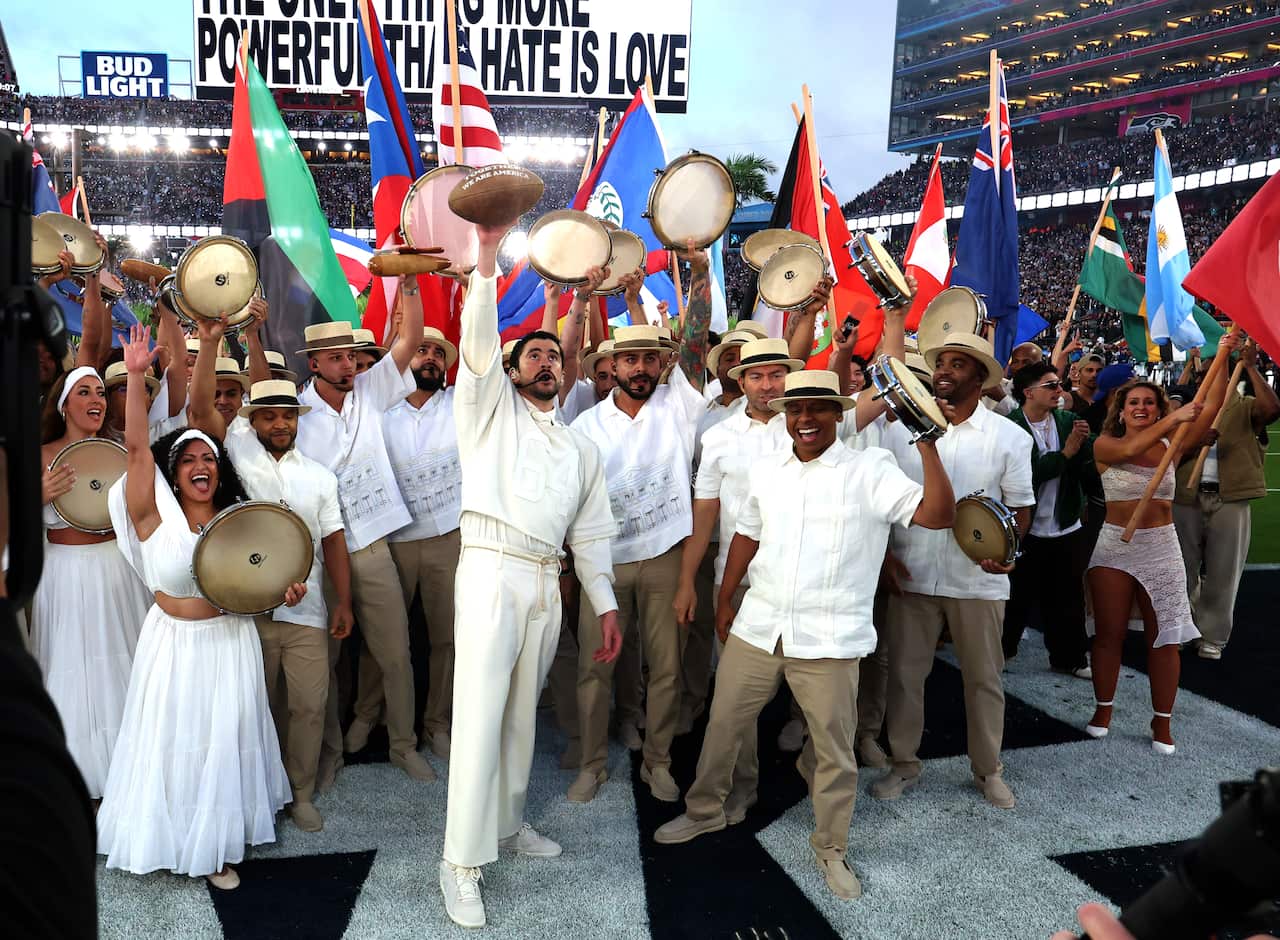
“It’s a statement about what’s going on with immigration in the US that’s very important to all of us,” Reyes said.
The performance as a whole, she said, struck a “perfect balance” between political messaging and giving English-speaking audiences the opportunity to party with Bad Bunny and learn about his culture.
‘Highly significant’ moment
Anna Nicola Henger, a scholar with the Iberian and Latin American Studies Collective, said Bad Bunny’s performance was a “highly significant” cultural moment. A Spanish-language artist hitting the mainstream at this level demonstrates “the enormous importance of Spanish-speaking peoples in the United States”.
Puerto Rico’s political status and lack of political representation in the US remains a “grey zone” and a source of tension, Henger told SBS News.
While the show attracted many rave reviews, it also drew fierce criticism from US President Donald Trump and those in his orbit. Trump posted on Truth Social that it “makes no sense, is an affront to the Greatness of America” and “nobody understands a word this guy is saying”.
“I think this is what Trump and co play on always, which is to create a fantasy belief around what the United States is about,” Henger said.
“Which is some kind of utopian white middle class space.”
“The actual reality of US history … is incredibly diverse and made up of people from such diverse cultures.”
“So of course, a performance by Bad Bunny representing the counter model to this fantasy … would not be something that the Trump camp like.”
For the latest from SBS News, download our app and subscribe to our newsletter.