


In Brief
- Australia is not compliant with its obligation to hold 90 days worth of net imports under the International Energy Agency treaty.
- Experts argue the fuel crisis is a catalyst for reassessing these terms and how we can reduce our oil product dependence.
Australia’s fuel reserves are in the spotlight as the war in the Middle East rages on.
Energy markets have been rattled and fuel prices have soared in the wake of the war, sparked by United States and Israeli strikes on Iran in late February.
Oil infrastructure is at risk, and the Strait of Hormuz — a key route for around a fifth of the world’s oil and gas exports on Iran’s southern border — has been choked off.
Significant disruptions to the global oil supply chain have in the past been alleviated by the release of oil stockpiles held by members of the International Energy Agency (IEA).
Australia is among 32 member states that signed an IEA treaty in the 1970s following Middle East oil shocks, committing to maintain 90 days of the previous year’s net oil imports.
However, it is the only member that does not meet this obligation, having failed to comply since 2012.
Last week, as the global energy watchdog announced the largest release of oil reserves in its history — 400 million barrels — Australia chose to fulfil its international duties by dispatching its reserves on home soil.
Energy Minister Chris Bowen announced 20 per cent of Australia’s stock of diesel and petrol reserves would be released to meet localised shortages, particularly in regional areas.
“It’s understandable that Australians are concerned about the fuel supply in Australia, but it’s also very important to be very clear that our minimum stock obligations are high and that fuel continues to arrive,” Bowen said.
But why is Australia in this predicament? And are more reserves really the answer?
From oil producer to ‘very vulnerable’
Australia’s oil production grew in the 1990s and peaked in 2000 at approximately 800,000 barrels per day (bpd) — far exceeding last year’s average production of 220,000 bpd.
Just over 20 years ago, Australia had eight oil refineries that met most of the country’s demand for refined fuel. But one by one, they were deemed economically unviable.
Kevin Morrison, an energy analyst for the Institute for Energy Economics and Financial Analysis, said in the early 2000s, Australia was “almost self-sufficient” before importing became cheaper.
“They (refineries) were quite old and sub-scale compared to some of the new refineries being built in Asia. So importers of fuel felt that it’s cheaper to import,” he told SBS News.
This led to the closure of six oil refineries, with only two remaining open: the Viva Energy facility in Geelong, Victoria, and the Ampol Lytton refinery in Brisbane, Queensland.
The switch to importing almost 90 per cent of our daily consumption — generally taken as refined product from South Korea, Japan, Singapore, Malaysia and Taiwan — leaves us “very vulnerable”, Morrison said.
“We haven’t taken out our insurance policy by adequately having sufficient stockpiles,” he said.
Why doesn’t Australia have more in reserve?
As of Saturday, Australia has 37 days’ worth of petrol (1.6 billion litres), 30 days’ supply of diesel (2.7 billion litres) and 29 days of jet fuel (800 million litres). This daily consumption measurement is different to the net import requirement under the IEA treaty.
The government’s release of emergency reserves, following the IEA’s recent request, equates to roughly six days of petrol and five days of diesel, with Bowen committing to reporting the above figures weekly, instead of monthly.
Tony Wood, senior fellow of the Grattan Institute’s energy program, said this release will provide comfort but is currently not necessary, as “fuel is still flying and flowing into Australia”.
He explains that diversity of supply has been the “deliberate” strategy to manage “our reserves, our resources, our backup”.
“Up until now, governments have decided that having that diversity of supply, complemented by a moderate amount of onshore storage, would be enough,” Wood said.
“We’d buy from a number of places, and that would still be far cheaper than trying to rebuild refineries in this country, particularly if we were going to be dependent upon imported crude oil anyway,” he added.
Wood said at present “we are not running out”, stressing most of our suppliers continue to be “reliable” through the crisis. Some, like South Korea, hold over 200 days of their national domestic demand.
To boost Australia’s supply levels, or “insurance policy”, the government would need to build more physical storage in places like ports, with Bowen estimating $20 billion would be needed over four years to build the infrastructure necessary to meet the IEA requirement.
Wood backed government action last week, which included the reserve release as well as temporarily changing fuel standards to higher sulphur levels, resulting in an additional 100 million litres per month for domestic consumers, as it’s blended with other fuels.
He highlighted that in 2024, Labor increased the minimum holding obligation for importers and wholesalers, particularly for diesel, boosting it from 20 to 32 days.
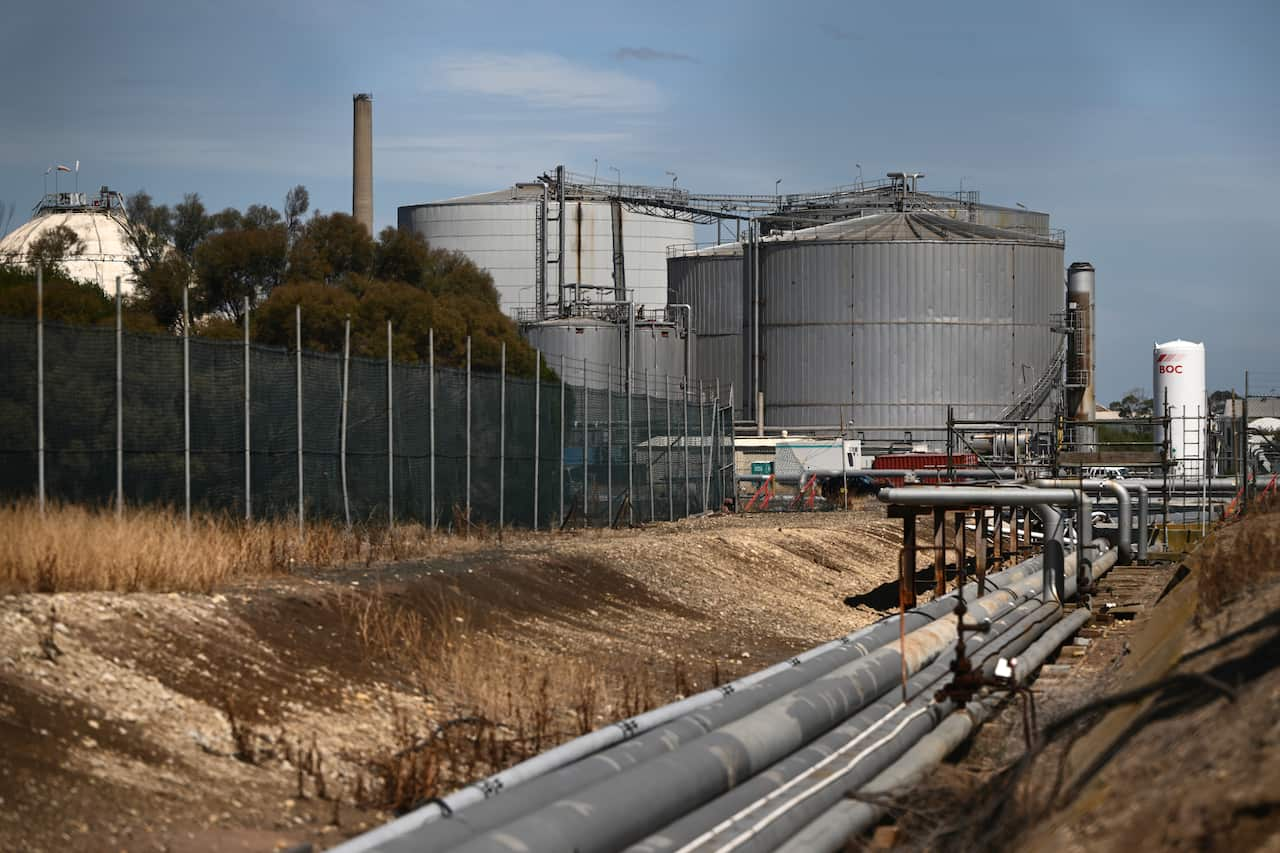
This followed an expansion of diesel storage onshore in 2021 by the Coalition government, which invested $260 million to increase it by approximately 780 million litres.
Morrison highlighted that, as well as the associated cost of storage, fuel is highly volatile and deteriorates, which means it can’t be stored forever.
“If we build more storage capacity, storage costs — so the Australian consumer is going to be paying a lot more for their diesel or for their petrol,” he said.
“But you know, those arguments kind of fall apart when you’re facing a situation like this.”
Should Australia reconsider its strategy?
Wood said our national reserves and Australia’s international obligations need to be considered separately.
In terms of the latter, he said “it seems silly” to be part of an agreement and not comply with it.
He suggests Australia renegotiate the terms of the agreement, given how much the market now relies on imports, making the IEA requirement harder to fulfil than when it was signed.
As for the domestic reserve, if it’s increased, the government needs to communicate to Australian residents that the associated costs will be passed on at the bowser.
Long term, both experts agree that the nation needs to consider whether it’s in a position to “gradually reduce its dependence upon oil products”, especially across transport.
“We’ve got to diversify our transportation needs. We can’t be so reliant on fossil fuels, you know, we’ve got to switch to electrics,” Morrison said.
“We’ve got to come out with policies that help our mining sector to electrify its fleet, so it’s not dependent on diesel. And the same applies to other industries, road freight … Longer haul freight trains. Same with agriculture.”
For the latest from SBS News, download our app and subscribe to our newsletter.