Part of the investigation into Sunday’s Bondi Beach massacre involves the trip alleged gunmen Sajid and Naveed Akram took to the southern Philippines a month prior.
Fifteen people were killed on Sunday in an attack on a Jewish Hanukkah celebration at Sydney’s Bondi Beach, which police allege was carried out by the father-son duo. It was Australia’s worst mass shooting since the 1996 Port Arthur massacre.
Australian Federal Police commissioner Krissy Barrett said early indications suggest the terrorist attack was inspired by the self-proclaimed Islamic State (IS) group, and that the pair had travelled to the Philippines last month.
Their travel to the Philippines is now a focus of counter-terrorism investigations. What authorities have not confirmed, and may never fully uncover, is what they did while there.
How long were the pair in the Philippines?
The Akrams were in the Philippines for almost the entire month of November, arriving back in Australia two weeks before the massacre.
The region is associated with terrorist organisations affiliated with the IS group.
Immigration records show the pair arrived on 1 November and left for Australia on 28 November.
Where did they stay?
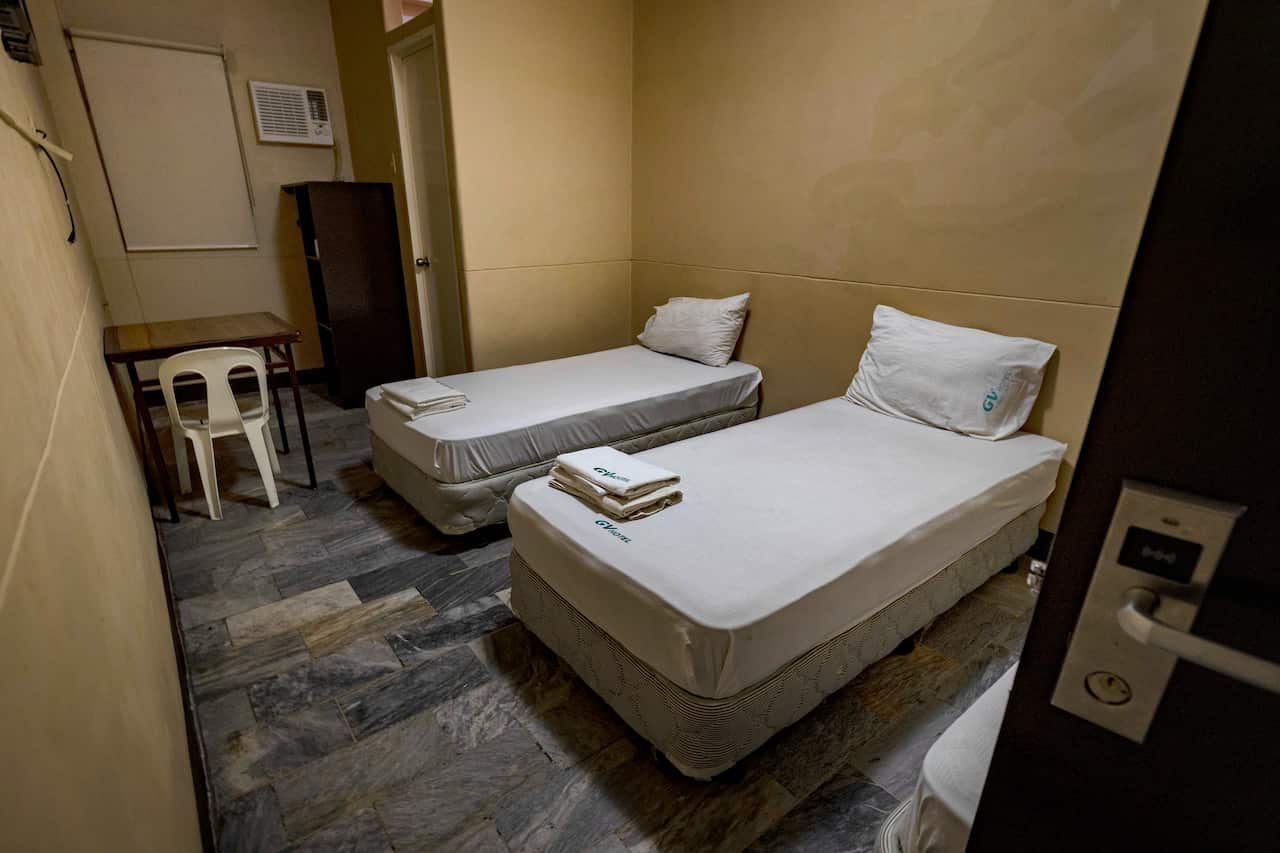
During their trip, they stayed in Davao on the southern island of Mindanao at a budget hotel in the city’s downtown area.
Philippines police visited the GV Hotel and confirmed on Wednesday the pair stayed there the entire time they were in Davao.
One of the rooms at GV Hotel where Sajid and Naveed Akram, suspects in the deadly Bondi Beach shooting, stayed last November. Source: Getty / Ezra Acayan
Staff of the GV Hotel said the pair rarely left the hotel and had minimal interactions with other guests or staff.
One staff member, who did not want to be named, told SBS Filipino that the pair “had some belongings, but not many — just enough”, according to their colleagues at the hotel.
One hotel worker, Jenelyn Sayson, told The Guardian the Akrams did not behave suspiciously during their stay.
Possible contact with an IS group
NSW Police said on Tuesday that the vehicle registered to Naveed Akram and driven to Bondi Beach contained improvised explosive devices and two homemade IS group flags.
Prime Minister Anthony Albanese said this week the evidence of the flags showed that the “radical perversion of Islam is absolutely a problem” both in the country and around the globe.
Authorities believe the two men evaded detection because they “weren’t part of a wider cell”.
But 24-year-old Naveed Akram, who has been charged with 15 counts of murder and one charge of committing a terrorist act and remains in hospital, was previously known to police.
He was investigated for six months by the Australian Security Intelligence Organisation (ASIO) in 2019 “because of his connections with two people who subsequently … went to jail,” Albanese said.
The GV Hotel in Davao is where the pair reportedly spent most of their time, according to local authorities and hotel staff. Source: Getty / Ezra Acayan
That investigation concluded there was no evidence he had been radicalised, and he was not subject to ongoing monitoring after the investigation ended. His father Sajid was shot dead by police during the Bondi attack.
It has not been confirmed if the Akrams have had contact with an IS group branch, whether virtually or in person in the Philippines.
Levi West, an ANU research fellow researching radicalisation, said that if the pair were trained by a terrorist organisation in the Philippines, they would have had to have built relationships before travelling there.
“You can’t just go to the southern Philippines and show up at an IS-run training camp and ask; there’s a level of connectivity and a set of relationships that you would need to have in place,” he told ABC Radio on Wednesday morning.
Were they trained by an IS group?
There is no evidence indicating that the pair received any form of military training while in the Philippines, the Philippines’ national security adviser said on Wednesday.
In a statement, Eduardo Año said a mere visit to the country does not substantiate allegations of terrorist training, and the length of their stay would not have allowed any meaningful or structured training.
Since the 2017 Marawi siege, a five-month battle in which the IS-inspired Maute group seized the southern city and fought government forces, Philippine troops have significantly degraded IS-affiliated groups, Año said.
“The remnants of these groups have been fragmented, deprived of leadership, and operationally degraded,” he added.
While authorities have described Sunday’s attack as “inspired by” the IS group, they have stopped short of confirming whether the Akrams received orders from the terror organisation.
What the pair hoped to achieve by going to the Philippines, and what they came back to Australia with, if anything, remains unknown.
Additional reporting from the Reuters News Agency and in collaboration with SBS Filipino